


The King Behind Dracula’s Origin Story
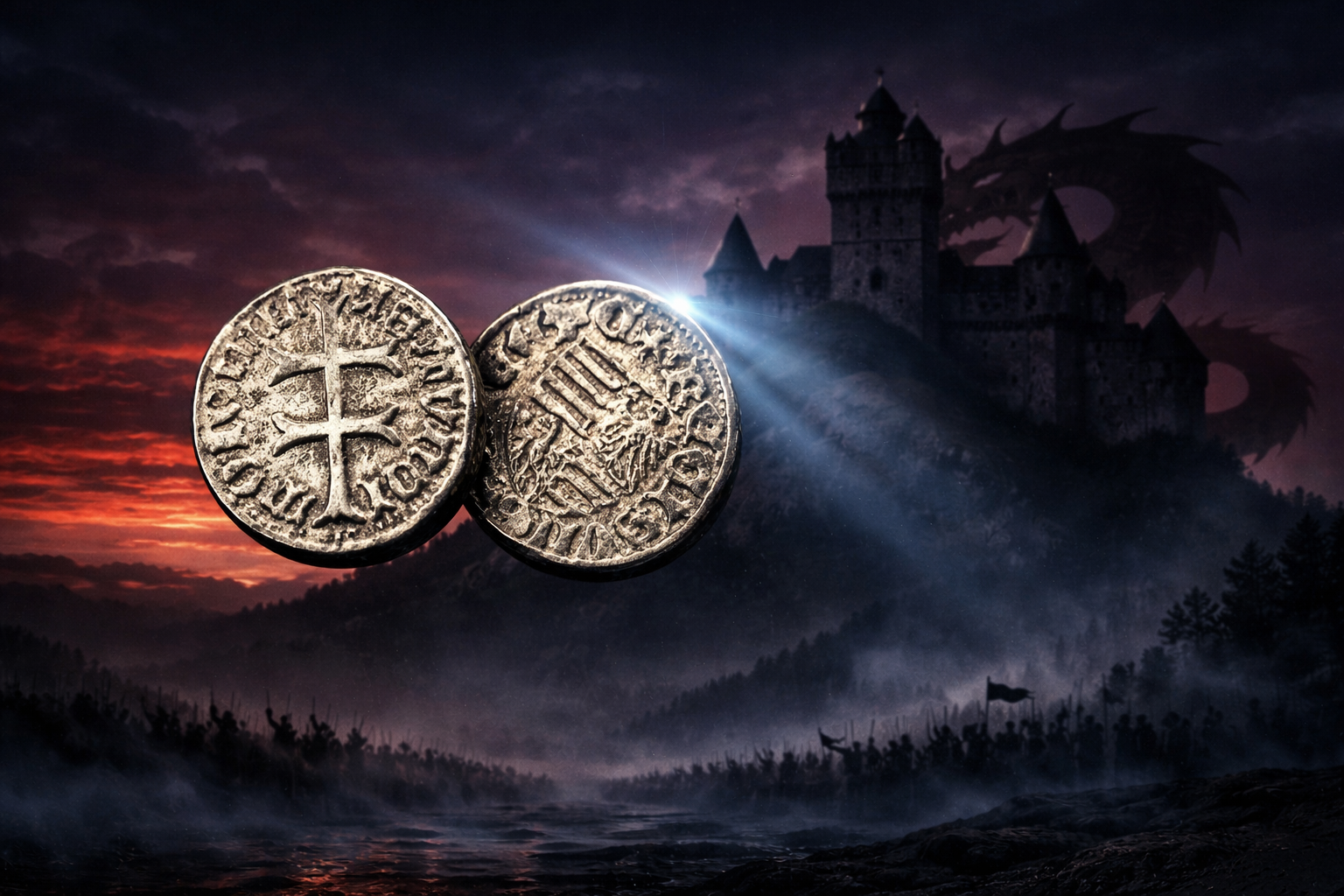
Medieval silver coins set against a twilight Transylvanian castle, evoking the Order of the Dragon and the real history behind Dracula.
In the early 1400s, Sigismund of Luxembourg ruled as King of Hungary and Croatia and later as Holy Roman Emperor, placing him at the center of European politics during the Ottoman advance into the Balkans. After the disastrous 1389 Battle of Kosovo, he built his reputation as a crusading monarch defending Christian Europe’s frontiers.
In 1408, Sigismund founded an elite chivalric society called the Order of the Dragon, a knightly brotherhood sworn to defend the cross and fight the Ottomans and heresy. Membership was restricted to high nobles and princes, and its emblem—dragon coiled around a cross—became one of the most powerful symbols of late–medieval crusading zeal.
From Order of the Dragon to “Dracula”
When Vlad II, a Wallachian prince ruling in the shadow of Transylvania, joined the Order of the Dragon in 1431, he received the nickname “Dracul,” the Romanian word for “dragon.” His son, Vlad III, inherited the patronymic, becoming “Dracula” – literally “son of the dragon,” not originally “son of the devil” as later horror stories suggest.
Vlad III Dracula would become infamous as “Vlad the Impaler,” a brutal defender of his small principality against Ottoman expansion, and the historical seed that Bram Stoker transformed into the modern vampire count. But the coin that quietly sits at the beginning of this chain of events is not a Transylvanian piece at all—it is the Hungarian silver denar struck for Sigismund, founder of the Order that gave Dracula his name.
What You See on the Silver Denar
The Sigismund silver denar was the standard medieval Hungarian small silver coin, struck in large numbers between about 1408 and 1437 during his long reign. These pieces were intended for everyday use, but their designs carry royal and crusader symbolism that links directly back to the Order of the Dragon and the defense of medieval Christendom.
Obverse: A compact royal coat of arms combining the double cross of Hungary with the arms of Luxembourg, surrounded by a Latin legend naming Sigismund as king.
Reverse: A bold cross reminiscent of Crusader and chivalric imagery, echoing the cross‑and‑dragon symbolism used by members of the Order of the Dragon.
Metal and size: Struck in silver, originally with a relatively high fineness for the period, though modern analysis suggests some denars slipped as low as around 60% silver in practice.
In hand, the coin is small but surprisingly charismatic—its medieval lettering, stylized shields, and simple cross tell you instantly that you are holding currency from the same world of castles, crusades, and frontier warfare that produced the Dracula legend.
Why It’s a Fun Starter Coin
For a new collector, Sigismund’s silver denar checks almost every box you want in a “first medieval coin.”
Real historical star power
You are not just buying a random medieval king—you are buying the founder of the Order of the Dragon, the exact order that gives “Dracul” and “Dracula” their names. This makes it incredibly easy to explain and share with friends: “This is the coin from the king who created Dracula’s order.”Clear, readable story
The narrative is clean: Ottoman pressure, a crusading king, a dragon‑order of knights, a Wallachian prince who becomes “Dracul,” and then his son “Dracula.” You can tell the whole story in a few sentences, which is perfect for show‑and‑tell, social media posts, or educational content.Affordable gateway into medieval Europe
Unlike rare gold florins or elite high‑grade ducats, typical Sigismund denars are often available in “collector grade” at approachable prices, especially when not slabbed or when moderately worn. That means you can own a roughly 590‑year‑old coin tied to a world‑famous legend without spending like a museum curator.A conversation between faith, fear, and folklore
Sigismund’s cross‑bearing denar, struck in silver, later intersects with the idea that silver harms vampires—a belief that grew in parallel with the Dracula mythos. It is almost poetic that the man who created Dracula’s chivalric order issued silver coins, while Dracula himself never minted his own currency at all.Easy to build a mini‑collection around
From this single starter coin, you can branch into:Other Hungarian issues of Sigismund, like parvus and quarting denominations.
Coins of Mircea the Elder, Vlad II, and later Balkan rulers on the Ottoman frontier.
Themed “Dracula and Transylvania” trays that pair coins with vampire‑era history and storytelling.
Why It Belongs in a New Collector’s Tray
This denar does more than sit in a flip with a date and name—it invites you to tell a story every time you open the album. In one coin, you get a crusading king, a secret dragon order, the origin of the name “Dracula,” and a direct link to the folklore that still fills books, movies, and October displays today.
For beginners, that means your very first medieval coin does what the best coins always should: it educates, entertains, and makes you want to learn more. And when that first coin happens to be the “Real Life Dracula” denar of Sigismund of Luxembourg, you are starting your collection with a story strong enough to hook even non‑collectors.